

Sustainability · 2025
In this section50 topics
- Sustainability Policy2 items
- Sustainability Goals & UN SDGs3 items
- Policy Review2 items
- Business Value Chain1 item
- Stakeholder Analysis2 items
- Environmental Policy & Guidelines3 items
- Environmental Policy Review1 item
- Energy — Plan & Guidelines2 items
- Energy — Electricity Consumption1 item
- Energy — Fuel Consumption1 item
- Energy — Targets3 items
- Energy — Performance & Outcomes2 items
- Water — Plan & Guidelines2 items
- Water — Withdrawal, Discharge & Consumption1 item
- Water — Targets1 item
- Water — Performance & Outcomes1 item
- Waste — Plan & Guidelines1 item
- Waste — Generation, Disposal & Recycling1 item
- Waste — Targets1 item
- Waste — Performance & Outcomes1 item
- GHG — Plan & Guidelines2 items
- GHG — Emissions2 items
- GHG — Emissions Verification3 items
- GHG — Principles & Standards1 item
- GHG — Targets1 item
- GHG — Performance & Outcomes1 item
- Environmental Legal Incidents1 item
- Other Environmental Management1 item
- Social Sustainability — Overview1 item
- Social Policy & Guidelines3 items
- Social Policy Review2 items
- Social — Principles & Standards Practised1 item
- Human Rights Due Diligence2 items
- Employees — Plan & Guidelines3 items
- Employees — Workforce1 item
- Employees — Remuneration & Provident Fund1 item
- Employees — Training & Development1 item
- Employees — Occupational Health & Safety1 item
- Employees — Labour Relations1 item
- Employees — Employee Representation2 items
- Employees — Targets2 items
- Employees — Performance & Outcomes2 items
- Customers — Plan & Guidelines3 items
- Customers — Satisfaction Results1 item
- Customers — Targets2 items
- Customers — Performance & Outcomes2 items
- Community & Social — Plan & Guidelines3 items
- Community & Social — Targets1 item
- Community & Social — Performance & Outcomes2 items
- Law Violation Incidents1 item
Sustainability Policy
Has a Sustainability Policy
Yes
Policy Description
The Company is determined to operate the business in line with the principles of sustainable development, ethical, adhere to the principles of good corporate governance under effective and transparent management, taking into account the stakeholders and realize responsibility towards society, community and environment to drive the organization to achieve its vision and goals according to the established strategies by adopting the Sufficiency Economy Philosophy and Sustainable Development Goals (SDGs) as a development framework for setting up the Sustainable Development Policy that are appropriate for the organization.
According to that intention, the Board of Directors at the meeting No. 13/2021, December 16, 2021, enacted “Sustainability Management Policy” This policy serves as a fundamental framework for managing the organization in a unified direction in accordance with the Company’s core value “TAE”. and set up a Corporate Sustainability Management Committee (CSM) consisting of senior executives and representatives from all departments within the Company. by assigning to all departments Responsible for each component of the system according to the process It outlines the operational procedures, mechanisms and processes for governance across the organization, explaining its commitment to sustainability management. according to the important issues in 3 dimensions, namely economy, society and environment.
Economic : Comply with the principles of good corporate governance business ethics Against all forms of corruption adapt to change develop new innovations Seek suitable opportunities for sustainable business development.
Environmental : Operating business in an environmentally friendly way. Control and minimize the impact on the ecosystem and biodiversity as well as mitigating and being more resilient to climate change for a sustainable coexistence.
Social : Conduct business responsibly. Respect the human rights principles. Protect labor rights, safety, health, and elevate working environment whilst continuously develop knowledge, skills and competency of employees. Apply organization core competency to create shared values and improve the quality of life of the community and society for sustainable growth.
All executives and employees are responsible for supporting and implementing this policy in accordance with the established guidelines, including communicating it to all stakeholders and fostering collaboration with leading organizations to enhance sustainable development capabilities.
Sustainability Goals & UN SDGs
Has Sustainability Goals
Yes
Goals Description
The Company is committed to becoming a leader in renewable energy production by delivering its value proposition of quality, safety, and sustainable energy solutions to all stakeholders. The Company operates in accordance with its vision, mission, and core values to achieve sustainable growth, while taking responsibility for its impacts on communities, society, and the environment under good corporate governance principles.
The Company has adopted the United Nations Sustainable Development Goals (SDGs) as a framework for its sustainability strategy, considering alignment with its business operations, value chain impacts, and material sustainability issues. The Company focuses on the SDGs where it can create tangible positive impacts, including:
Goal 7: Affordable and Clean Energy – aligned with the Company’s renewable energy business
Goal 8: Decent Work and Economic Growth – through fair employment and employee development
Goal 9: Industry, Innovation and Infrastructure – through the application of innovation and technology
Goal 12: Responsible Consumption and Production – through efficient resource and supply chain management
Goal 13: Climate Action – through greenhouse gas emission control and reduction
Goal 16: Peace, Justice and Strong Institutions – through good corporate governance and anti-corruption practices
Goal 17: Partnerships for the Goals – through collaboration with stakeholders
The Company’s sustainability strategy is aligned with these SDGs across three key dimensions:
Economic and Governance Dimension
The Company aims to create economic value through high-quality products under strong corporate governance. Emphasis is placed on transparency, fairness, accountability, anti-corruption practices, and effective risk management. This is supported by responsible sourcing, safe production processes, occupational health and safety, environmental management, and the application of modern technology and innovation to deliver sustainable energy solutions.
Short-term and Long-term Targets
(1) Anti-corruption: To support and encourage at least one business partner to declare its intention and complete self-assessment to become a member of the Thailand’s Private Sector Collective Action Against Corruption (CAC) by 2026.
(2) Sustainable supply chain management: To ensure that 100% of key suppliers acknowledge and sign the “Corporate Governance and Business Ethics Policy” by 2026.
(3) Cost and resource efficiency: To enhance efficiency in energy and utility consumption to strengthen profitability, focusing on continuous improvement in energy cost per unit and production efficiency.
Social Dimension
The Company emphasizes “Human Excellence,” recognizing employees as key drivers of sustainable growth. Equal development opportunities are provided regardless of gender or physical conditions through training and capability development programs to enhance competitiveness and adaptability. Teamwork, collaboration, and employee engagement are also promoted to achieve organizational goals.
In addition, the Company operates with social responsibility by contributing to community development in areas such as public utilities, local employment, economic development, education, arts and culture, as well as health and safety of communities and stakeholders.
Short-term and Long-term Targets
(1) Employee development: To increase average training hours for employees at all levels to no less than 18 hours per person per year by 2026.
(2) Local employment: To maintain more than 80% of plant employees as local residents of Suphan Buri Province on a continuous basis.
Environmental Dimension
The Company operates with a strong commitment to environmental stewardship by focusing on efficient resource utilization, greenhouse gas emission control, energy conservation, water and waste management, and minimizing impacts on ecosystems and biodiversity to ensure sustainable coexistence with the environment.
Short-term and Long-term Targets
The Company is in the process of developing and refining its greenhouse gas data collection and calculation methodologies to align with relevant standards, which will support the establishment of long-term targets for reducing greenhouse gas emissions in the future.
UN Sustainable Development Goals
| SDG Goal |
|---|
| Goal 7 Affordable and Clean Energy |
| Goal 7 Affordable and Clean Energy |
| Goal 7 Affordable and Clean Energy |
| Goal 7 Affordable and Clean Energy |
| Goal 8 Decent Work and Economic Growth |
| Goal 8 Decent Work and Economic Growth |
| Goal 8 Decent Work and Economic Growth |
| Goal 8 Decent Work and Economic Growth |
| Goal 9 Industry, Innovation and Infrastructure |
| Goal 12 Responsible Consumption and Production |
| Goal 12 Responsible Consumption and Production |
| Goal 12 Responsible Consumption and Production |
| Goal 12 Responsible Consumption and Production |
| Goal 13 Climate Action |
| Goal 13 Climate Action |
| Goal 13 Climate Action |
| Goal 13 Climate Action |
| Goal 16 Peace, Justice and Strong Institutions |
| Goal 16 Peace, Justice and Strong Institutions |
| Goal 16 Peace, Justice and Strong Institutions |
| Goal 16 Peace, Justice and Strong Institutions |
| Goal 17 Partnerships for the Goals |
| Goal 17 Partnerships for the Goals |
| Goal 17 Partnerships for the Goals |
| Goal 17 Partnerships for the Goals |
Policy Review
Policy Reviewed This Year
Yes
Policy Changed This Year
No
Business Value Chain
Value Chain Description
The Company values management throughout the value chain. To create value for products and services to meet the expectations of stakeholders from purchasing raw materials from domestic and international deliverers, production that must take into account the impact on the community and be environmentally friendly, marketing and delivery of quality products is standardized and reaching customers or consumers quickly.
Moreover, the Company aims for business partners to operate in an ethical manner, respect for human rights,social responsibility with good governance principles as well as a management on occupational health and safety. At the same time, the Company expects its partners to pay more attention to related environmental management in order to develop the mutual potential enhancement of the competitiveness in the future. Therefore, the Company establishes Business Ethics in relation to the partner and communicates to both domestic and international partners and discloses it on the Company's website for all stakeholders to know, as well as to disclose relevant action on the topic of value chain management in the Annual Report 2021 (Form 56-1 One Report).
The seven main stakeholders are:
(1) Employees : Executives and employees of the Company, whether full-time, daily, part-time or foreign employees.
(2) Customers : Oil traders under Section 7, Business Sector (B2B) customers and consumers.
(3) Supplier : Suppliers, raw materials suppliers, shipping carrier, freighters, tool and machine manufacturers, partnership and business partners.
(4) Shareholders : Shareholders and General Investors.
(5) Community & Society : Communities nearby the factory, general public, youth, educational institutions, local politicians and non-governmental organizations (NGOs), local and national media.
(6) Competitor : Entrepreneurs in the same business or industry, commercial competitors.
(7) Government agencies and regulators : Government, local government, policymakers or supervisors Courts, independent organizations.
Stakeholder Analysis
Introduction
The Company analyzes key stakeholders both inside and outside the organization who are connected to the value chain of business and value participation by two-way communication. Open opportunity to listen to feedback, opinions, to reflect the needs and expectations of stakeholders in the Company's business operations. This ensures that the basic legal rights relating to stakeholders are protected, maintained fairly, equality and benefit to all stakeholders involved in the Company's business operations. This can be classified into 7 main groups as follows:
Stakeholder Analysis
| Stakeholder Type | Stakeholders | Stakeholder Expectations | Response to Expectations | Communication Activities |
|---|---|---|---|---|
| Internal stakeholders | 2921 · Description: Employees | (1) Welfare and good compensation
(2) Career stability and Promotion
(3) Safety and occupational health
(4) Development of knowledge and capability
| (1) Good compensation and appropriate welfare
(2) Fair and equitable evaluation, Opportunities for promotion and migration
(3) Job valuation
(4) Providing a good working environment
(5) Creating an organizational culture and awareness of safety in the workplace
(6) Compliance with Human Rights policy | 2941 · Description: Online Communication · 2942 · Description: Internal Meeting · 2945 · Description: Complaint Reception · 2946 · Description: Employee Engagement Survey · 2949 · Other name: Labor Relations Activities · Description: Others |
| External stakeholders | 2923 · Description: Customers | (1) Quality product
(2) Supporting for knowledge of product information
(3) Delivery of products complete, accurate and on time.
(4) Service satisfaction | (1) Quality and safety production process
(2) Development and improvement of production processes by using technology, innovation and promotion of product research and development. | 2938 · Description: Visit · 2945 · Description: Complaint Reception · 2947 · Description: Satisfaction Survey |
| External stakeholders | 2899 · Description: Suppliers | (1) Transparent and fair business operation | (1) Conduct business with fairness, transparency and accountability
(2) Prohibiting direct and indirect payment of any dishonest benefts
(3) Traceability Of Suppliers | 2938 · Description: Visit · 2943 · Description: External Meeting · 2945 · Description: Complaint Reception |
| Internal stakeholders | 2913 · Description: Shareholders | (1) Good performance and
sustainable business growth
(2) Good corporate governance
(3) Satisfactory dividend payment | (1) Conduct business on the basis of ethics, good governance principles and good corporate governance.
(2) Legal compliance and disclose information with transparency and fairness
(3) Appropriate dividend payment to shareholders according to the Company’s dividend policy | 2941 · Description: Online Communication · 2944 · Description: Annual General Meeting (AGM) · 2945 · Description: Complaint Reception |
| External stakeholders | 2902 · Description: Community · 2928 · Description: Society | (1) Paying attention to the community’s voice
(2) The complaints are fairly
resolved
(3) Conducting business
with safety and social
responsibility
(4) Supporting community
activities
| (1) Responsible operations for impacts in the production process
(2) Responsible operations for impacts in the production process
(3) Compliance with regulations and laws
(4) Employment that distributes income to the community
(5) Supporting quality of well-being, develop communities, society and preserve local culture traditions.
| 2940 · Description: Social Event · 2941 · Description: Online Communication · 2942 · Description: Internal Meeting · 2943 · Description: External Meeting · 2945 · Description: Complaint Reception · 2949 · Other name: The emergency response team will monitor, provide assistance and as solve problems for 24 hours · Description: Others · 2949 · Other name: Meeting with community leaders and government agencies by establishing a collaborative working group between the Company and community representatives. · Description: Others |
| External stakeholders | 2898 · Description: Competitors | (1) Conducting business with honesty, transparency and fairness | (1) Conducting business under
good competition rules
(2) Do not destroy the
reputation of competitors
for business benefts
| 2945 · Description: Complaint Reception |
| External stakeholders | 2931 · Description: Government agencies and Regulators | (1) Compliance with legal requirements and operational transparency.
(2) Responsibility to society,
communities and the
environment.
(3) Cooperating in various
activities.
| (1) Strictly comply with relevant laws, regulations along with Company policies
(2) Conduct business with accuracy, transparency. Comply with corporate governance and anti-corruption principles.
(3) Cooperate and support government projects
| 2941 · Description: Online Communication · 2949 · Other name: Meetings, discussions and clarified · Description: Others · 2949 · Other name: Participation in government agencies project. · Description: Others |
Environmental Policy & Guidelines
Has an Environmental Policy
Yes
Policy Description
The Company realizes the importance of prevention and is responsible for the impacts that may arise from its operations both inside and outside the workplace. Therefore, the Company has established the “Environmental Policy” to promote the development of the production process and create innovations that reduce as well as aim for the most effcient usage of resources, reduce greenhouse gas emissions, manage water systematically, including protect the ecosystems and biodiversity.
In addition, the Company has established a "Resource Conservation Policy" to guide the operation. Promote the efficient and optimal use of resources by making resource conservation part of the Company's operations. Continuously and appropriately improve the efficiency of the use of corporate resources. It is the responsibility of all executives and employees. The Company publishes such policies on the Company's website www.thaiagroenergy.com.
In 2021, the Company appointed the "Corporate Sustainability Management Committee (CSM)” , which consists of representatives from the relevant departments to integrate environmental information into the work process in all aspects, including energy consumption, water management, waste management, carbon footprint reduction. This leads to set goals to reduce short-term and long-term resource usage and reduce the impact arising from the production process, along with able to resolve problems and complaints and report the operation to the Board of Directors for acknowledgment.
Environmental Practices
The Company operates based on the principles of pollution prevention at the source and efficient resource utilization. This covers process control, resource usage, waste management, and continuous monitoring of environmental impacts, as well as strict compliance with applicable environmental laws and regulations.
Electricity Management
The Company manages electricity consumption efficiently by monitoring, measuring, and analyzing energy usage in the production processes on a regular basis. This enables continuous improvement in energy efficiency, reduction of energy losses, and effective cost control.
In addition, the Company utilizes biogas generated from wastewater treatment as a fuel to produce electricity for internal use within the plant. This reduces dependence on external energy sources, enhances energy efficiency, and continuously reduces greenhouse gas emissions.
The Company also continuously monitors and evaluates electricity consumption efficiency and promotes appropriate and efficient energy use to support overall energy reduction.
Fuel and Oil Management
The Company places importance on the safe storage and usage of fuel and oil, with measures in place to prevent leakage, ensure proper storage, and promote efficient usage. This minimizes environmental risks and ensures employee safety, while strictly complying with relevant laws and regulations.
The Company also conducts regular inspections and maintenance of equipment related to fuel and oil storage and usage to prevent leakage and reduce environmental impacts.
Renewable / Clean Energy Management
The Company recognizes the importance of treating wastewater through biogas production to reduce odor-related impacts. The generated biogas is used as fuel for gas engines, serving as a key renewable energy source.
The Company began utilizing biogas energy from its first production pond using Anaerobic Baffled Reactor (ABR) technology in January 2006 and has continuously expanded its capacity. Currently, the Company operates four treatment ponds with a maximum capacity of 8,100 cubic meters per hour.
The Company continues to promote the use of renewable energy to reduce dependence on fossil fuels and support environmentally friendly operations.
Water Resource and Water Quality Management
The Company focuses on comprehensive wastewater management. One key outcome is the reduction of water consumption in the production process through data collection and analysis of water usage across clean water production, production processes, supporting activities, and wastewater treatment systems. This leads to the efficient utilization of water resources.
All wastewater from the production process is treated through an Anaerobic Digester system. The treated water is then used as fertilizer for economic crops and allowed to evaporate naturally, with no discharge outside the facility. The Water Management Department monitors water quality through in-house laboratory testing and conducts daily inspections of treatment ponds, including physical characteristics, pond levels, water levels, and pipelines. External laboratory testing is also conducted on a monthly basis.
The Company emphasizes efficient water usage throughout the production chain by continuously monitoring and analyzing water consumption data to improve water efficiency, reduce losses, and optimize usage in the long term. Water quality is strictly controlled in compliance with legal standards.
Waste and By-product Management
The Company manages waste in accordance with the 3Rs principle (Reduce, Reuse, Recycle), focusing on minimizing waste at the source, maximizing reuse, and ensuring proper disposal in compliance with legal requirements to reduce environmental impacts.
In addition, the Company converts production waste into value-added products. Vinasse is processed through evaporation to produce potassium humate soil conditioner for sale. Cassava residue, the main raw material, is dried and sold as animal feed. This enhances resource value, reduces waste generation, and supports the circular economy concept.
The Company continuously monitors waste generation and evaluates waste management efficiency to further improve processes.
Biodiversity Management
The Company recognizes the importance of biodiversity conservation by controlling production activities to avoid impacts on surrounding ecosystems, promoting sustainable use of natural resources, and maintaining environmental conditions within operational areas.
The Company also implements economic forest plantation projects by promoting the cultivation of Katin Thepa trees in suitable areas to increase green spaces and absorb carbon dioxide. Additionally, the Company distributes plant seedlings to communities and interested organizations for sustainable use, contributing to natural resource conservation and ecological balance in the long term.
The Company continuously monitors and maintains green areas to ensure long-term environmental benefits.
Greenhouse Gas Management and Climate Change Mitigation
The Company is committed to minimizing the impact of its business operations on climate change by emphasizing efficient resource utilization, energy management, energy conservation, and energy-saving measures to reduce greenhouse gas emissions.
In 2021, the Company participated in the “Expansion Program to Promote Organizational Carbon Footprint in the Industrial Sector (Phase 11)” under the Federation of Thai Industries and was selected as a pilot organization, with Mahidol University serving as an advisor. The advisory costs were supported by the program.
Subsequently, the Company has continuously managed greenhouse gas emissions. From 2022 to 2025, the Company has conducted annual assessments of greenhouse gas emissions and removals. The baseline year was revised to 2024 (B.E. 2567) to better reflect actual operational conditions and calculation methodologies.
The Company has received certification from the Thailand Greenhouse Gas Management Organization (Public Organization) covering data up to 2024 and is currently in the process of renewing certification for 2025 data.
The Company continues to develop measures to reduce greenhouse gas emissions, focusing on improving energy efficiency and increasing the use of renewable energy.
Air Quality Management
The Company has invested in installing Hydrogen Sulfide (H2S) removal systems in biogas used as fuel for steam and electricity generation. This reduces Sulfur Oxides (SOx) emissions in flue gas from boilers and prevents air pollution that may affect surrounding communities.
The first installation was in June 2015, and the number of bio-scrubber tanks has been continuously increased to five units at present. Biogas is treated through the bio-scrubber system before use to reduce hydrogen sulfide levels.
The Company regularly monitors and controls air emissions to ensure compliance with applicable standards.
Noise Pollution Management
The Company has implemented measures to control noise levels from machinery and production processes to meet regulatory standards. Noise levels are regularly monitored, and improvements are made to prevent impacts on employees and surrounding communities.
The Company also emphasizes noise prevention by maintaining machinery and equipment appropriately.
Environmental Guidelines
| Guideline |
|---|
| Electricity Management |
| Fuel Management |
| Renewable/Clean Energy Management |
| Water Management |
| Waste Management |
| Biodiversity Management |
| Greenhouse Gas and Climate Change Management |
| Air Quality Management |
| Noise Pollution Management |
Environmental Policy Review
Policy Reviewed This Year
Yes
Energy — Plan & Guidelines
Has an Energy Management Plan
Yes
Plan Description
The Company places importance on efficient energy management and has established an Energy Management Committee within the plant to oversee and drive energy conservation initiatives. The Committee ensures that energy management is conducted effectively and in compliance with the Energy Conservation Promotion Act B.E. 2535 (1992), as amended, as well as other relevant regulations. The Committee is responsible for formulating policies, plans, and energy conservation measures, as well as monitoring and evaluating performance on a continuous basis.
The Company has developed an energy conservation plan covering both electricity and thermal energy, with the objective of reducing energy consumption, minimizing losses in the production process, and continuously improving the efficiency of machinery and equipment. The plan clearly defines measures, implementation timelines, and responsible persons.
For the electricity conservation plan, the Company focuses on enhancing energy efficiency in cooling systems and production processes by optimizing equipment performance in accordance with actual operating conditions. In addition, measures have been implemented to reduce energy losses during idle periods of conveyor systems within the production process.
These measures aim to directly reduce electricity consumption in production and are scheduled for implementation from March to June 2026, without requiring additional investment.
For the thermal energy conservation plan, the Company focuses on improving the efficiency of steam generation systems and heat transfer processes. This is achieved through equipment improvement and preventive maintenance to reduce heat loss, minimize fuel consumption, and enhance overall machine performance.
The measures include equipment upgrades, preventive maintenance, and improvements in heat transfer efficiency within the production process, with implementation scheduled from January to November 2026.
The implementation of these measures reflects the Company’s commitment to systematically improving energy efficiency, encompassing equipment upgrades, preventive maintenance, and reduction of energy losses in production processes. These efforts support the reduction of energy costs, efficient resource utilization, and mitigation of environmental impacts in the long term.
The Company will continuously monitor and evaluate the performance of these measures in order to further improve its energy management plan and implement additional measures that are appropriate to the plant’s operational conditions in the future.
Energy — Electricity Consumption
Electricity Consumption
| Metric | Current Year | Previous Year | Two Years Ago |
|---|---|---|---|
| Total electricity consumption within the organization (Kilowatt-Hours) | 27,573,525 | 26,260,853 | 28,000,000 |
| Electricity purchased for consumption from non-renewable energy sources (Kilowatt-Hours) | 15,627,040 | 21,136,627 | 16,000,000 |
| Electricity purchased or generated for consumption from renewable energy sources (Kilowatt-Hours) | 11,946,485 | 5,124,226 | 12,000,000 |
Energy — Fuel Consumption
Fuel Consumption
| Metric | Current Year | Previous Year | Two Years Ago |
|---|---|---|---|
| Crude oil (Barrels) | |||
| Coal (Metric tonnes) | |||
| Jet fuel (Litres) | |||
| Diesel (Litres) | 85,465.22 | 104,216.18 | 70,441 |
| Gasoline (Litres) | 0 | 3,858 | 4,334 |
| Fuel oil (Litres) | 15,400 | 36,900 | 101,600 |
| Natural gas (Standard cubic feet) | |||
| LPG (Kilograms) | |||
| Steam (Metric tonnes) | 213,142 | 237,512.27 | 203,806 |
Energy — Targets
Introduction
The Company has set a target to reduce electricity purchases from external sources by enhancing energy efficiency and promoting the use of renewable energy from biogas.
The Company initially used 2022 as the baseline and continuously monitored performance on a year-on-year basis. Subsequently, the baseline was revised to 2024 to better reflect current operational conditions.
In 2025, the Company successfully achieved its electricity reduction target and has set a further target to reduce electricity consumption by an additional 10% in 2026, in order to continuously improve energy efficiency.
Has Set Targets
Yes
Targets
| Target | Base Year | Base Year Value | Target Year | Target Change (%) | Unit |
|---|---|---|---|---|---|
| Reduction of electricity purchased for consumption | 2,025 | 15,627,040 | 2,026 | 10 | Kilowatt-hour |
Energy — Performance & Outcomes
Has Performance Results
Yes
Performance Description
Water Resource and Quality Management / Renewable Energy / Clean Energy
In 2025, the total volume of wastewater generated from the ethanol production process (spent wash) amounted to 677,120 cubic meters. This wastewater was utilized to produce a total of 35,572,080 cubic meters of biogas. The biogas produced was distributed for use as fuel in boilers and for electricity generation through gas engines.
In 2025, the Company generated a total of 213,142 tons of steam.
Electricity Management
In 2025, the Company’s ethanol production plant consumed approximately 27,573,525 kilowatt-hours of electricity. Of this total, 11,946,485 kilowatt-hours, or 43.33%, was generated internally, while the remaining 15,627,040 kilowatt-hours, or 56.67%, was procured from the Provincial Electricity Authority (PEA).
Water — Plan & Guidelines
Has a Water Management Plan
No
Plan Description
Currently, the Company manages spent wash from the production process by utilizing it for biogas production, while the remaining portion is used to produce potassium humate soil conditioner. As for the overall water management plan, the Company is in the process of developing a comprehensive plan.
Water — Withdrawal, Discharge & Consumption
Water Withdrawal, Discharge & Consumption
| Metric | Current Year | Previous Year | Two Years Ago |
|---|---|---|---|
| Total water withdrawal (Cubic meters) | 1,024,469 | 1,029,874.88 | 1,042,204 |
| Total water withdrawal by third-party water (Cubic meters) | 1,024,469 | 1,029,874.88 | 1,042,204 |
| Total water withdrawal by surface water (Cubic meters) | |||
| Total water withdrawal by groundwater (Cubic meters) | |||
| Total water withdrawal by seawater (Cubic meters) | |||
| Total water withdrawal by produced water (Cubic meters) | |||
| Percentage of wastewater treated before discharge (%) | |||
| Total water discharge (Cubic meters) | |||
| Total water discharge to third-party water (Cubic meters) | |||
| Total water discharge to surface water (Cubic meters) | |||
| Total water discharge to groundwater (Cubic meters) | |||
| Total water discharge to seawater (Cubic meters) | |||
| Total water consumption (Cubic meters) | 1,024,469 | 1,029,874.88 | 1,042,204 |
| Recycled water (Cubic meters) |
Water — Targets
Has Set Targets
No
Water — Performance & Outcomes
Has Performance Results
No
Waste — Plan & Guidelines
Has a Waste Management Plan
No
Waste — Generation, Disposal & Recycling
Waste Generation, Disposal & Recycling
| Metric |
|---|
| Total waste generated (Kilograms) |
| Non-hazardous waste (Kilograms) |
| Non-hazardous waste - Landfilling (Kilograms) |
| Non-hazardous waste - Incineration (with energy recovery) (Kilograms) |
| Non-hazardous waste - Incineration (without energy recovery) (Kilograms) |
| Non-hazardous waste - Other disposal operations (Kilograms) |
| Hazardous waste (Kilograms) |
| Hazardous waste - Landfilling (Kilograms) |
| Hazardous waste - Incineration (with energy recovery) (Kilograms) |
| Hazardous waste - Incineration (without energy recovery) (Kilograms) |
| Hazardous waste - Other disposal operations (Kilograms) |
| Total reused/recycled waste (Kilograms) |
| Reused/Recycled non-hazardous waste (Kilograms) |
| Reused non-hazardous waste (Kilograms) |
| Recycled non-hazardous waste (Kilograms) |
| Reused/Recycled hazardous waste (Kilograms) |
| Reused hazardous waste (Kilograms) |
| Recycled hazardous waste (Kilograms) |
Waste — Targets
Has Set Targets
No
Waste — Performance & Outcomes
Has Performance Results
No
GHG — Plan & Guidelines
Has a GHG Management Plan
No
Plan Description
Currently, the Company has implemented an economic forest planting project and is in the process of developing a long-term greenhouse gas reduction plan.
GHG — Emissions
Introduction
Carbon Footprint Reduction and Greenhouse Gas Emission Mitigation
The Company prioritizes minimizing the impact of its business operations on climate change by utilizing resources efficiently. This includes energy management, energy conservation, and energy-saving initiatives to help reduce greenhouse gas emissions. From 2021 to 2026, the company has undertaken various initiatives as follows:
Greenhouse Gas Emission Control
Since 2021, the Company has participated in the Industrial Carbon Footprint Expansion Program for the fiscal year 2022 (Phase 11), organized by the Federation of Thai Industries. The company was selected as a pilot industry for the program and received support in securing a consulting team from Mahidol University, led by Dr. Suwin Apichatpattanasee. Additionally, the company received financial support (consulting fees) from the program to develop its carbon footprint assessment.
2022: The Company conducted its first greenhouse gas emission and absorption assessment. This assessment was certified by the Thailand Greenhouse Gas Management Organization (TGO) on August 23, 2022, with verification conducted by a consulting team from Mahidol University, led by Dr. Suwin Apichatpattanasee, and a verification team from ECEE Co., Ltd.
2023: The Company assessed its greenhouse gas emissions and absorption for 2022. The assessment was certified by the Thailand Greenhouse Gas Management Organization (TGO) on August 28, 2023, with verification conducted by ECEE Co., Ltd.
2024: The Company conducted its greenhouse gas emissions and absorption assessment for 2023, which was certified by the Thailand Greenhouse Gas Management Organization (TGO) on November 26, 2024, with verification by ECEE Co., Ltd.
2025, the Company conducted its greenhouse gas emissions and absorption assessment for 2024, which was certified by the Thailand Greenhouse Gas Management Organization (TGO) on November 25, 2025, with verification by ECEE Co., Ltd.
2026, the Company conducted its greenhouse gas emissions and absorption assessment for 2025 and is currently in the process of applying for certification from the Thailand Greenhouse Gas Management Organization (TGO) in the meeting no. 2/2026. The results are scheduled to be announced on April 22, 2026, with verification by ECEE Co., Ltd.
The Company’s greenhouse gas emissions reports for 2023 to 2025 are as follows:
GHG Emissions
| Metric | Current Year | Previous Year | Two Years Ago |
|---|---|---|---|
| Total GHG emissions (Metric tonnes of carbon dioxide equivalent) | 62,349 | 29,991 | 257,665 |
| Total greenhouse gas emissions 1 (Metric tonnes of carbon dioxide equivalent) | 53,625 | 17,295 | 250,339 |
| Total greenhouse gas emissions 2 (Metric tonnes of carbon dioxide equivalent) | 7,423 | 10,558 | 6,062 |
| Total greenhouse gas emissions 3 (Metric tonnes of carbon dioxide equivalent) | 1,301 | 2,138 | 1,264 |
GHG — Emissions Verification
Emissions Verified by a Third Party
Yes
Verifying Body
2656
Verifying Body — Please Specify
ECEE Co., Ltd.
GHG — Principles & Standards
Principles & Standards Applied
| Standard |
|---|
| 2671 |
GHG — Targets
Has Set GHG Targets
No
GHG — Performance & Outcomes
Has Performance Results
No
Environmental Legal Incidents
Legal Violation Incidents
| Metric | Current Year | Previous Year | Two Years Ago |
|---|---|---|---|
| Number of cases or incidents of legal violations or negative environmental impact (cases) | 0 | 0 | 0 |
Other Environmental Management
Plan Description
The Company is aware of the impact of operations on the environment, safety and occupational health, as well as the quality of life and health of the people living nearby. Therefore, the Company has continuously monitored and measured the environmental quality and strictly according to the relevant laws. From the results of the environmental quality measurement monitoring results, it was found that air quality, noise quality, water quality and waste management from production processes within the standard as required by law.
In addition to complying with the above laws, The Company's production process holds Quality Management System ISO 9001: 2015 certification and Environmental Management System ISO 14001: 2015 certification from The United Kingdom Accreditation Service (UKAS), United Kingdom and The National Accreditation Council of Thailand – NAC, Thailand as well.
In this regard with a commitment to reduce environmental impact The Company has also implemented a project to improve the efficiency of the production process to continuously reduce the impact on the environment as follows:
Environmental Impact Reduction on Air Pollution Project
The Company installed bio scrubber for removal hydrogen sulfide (H2S) in biogas, which is used for steam and power generation for the biogas to make biogas clean and has better quality. Additionally, there is a working team monitoring and inspecting the emission of pollution from the end of the shaft to meet the government standards with plan to maintain or replace the canvas covering biogas ponds before the expiration of its use to ensure that it is in good condition in order to prevent and minimize air pollution that would have an impact on the surrounding community.
Environmental Impact Reduction on Water Resources and Wastewater Treatment Project
The Company has complied with the requirements of the government in “Wastewater Management in Industrial Plants” by constructing properly treated spent wash ponds from biogas production process with inspection and repair of the levees in accordance with the engineering standards with adequate freeboard distance to reduce the risk of the overflows caused by heavy rains. In addition, The Company has started running the machinery of the spent wash evaporation plant in order to reduce the treated spent wash and mitigate the risk of water leakage in the event of flooding to ensure safety and to prevent the potential impact on the surrounding community.
Economic Forest Plantation Project: A Greenhouse Gas Reduction Initiative for the Environment
The Company places great importance on reducing greenhouse gas emissions and increasing green spaces through the Economic Forest Plantation Project at its factory site in Dan Chang District, Suphan Buri Province. As of December 31, 2025, a total of 672 rai of trees have been planted, with an estimated CO2 absorption capacity of no less than 2,700 tons per year.
Project Achievements in 2025
Seedling Preparation – A total of 169,470 seedlings were cultivated, including 126,252 Kratin Thepa and 43,218 Kratin Narong.
Tree planting – A total of 37,367 trees were planted.
Maintenance – An irrigation system has been installed, boundary markers have been placed, and periodic maintenance such as pruning, weed control, and growth monitoring every six months has been conducted.
Project Summary - The Company's Economic Forest Plantation Project plays a vital role in increasing green areas and reducing greenhouse gas emissions into the atmosphere. It also promotes forest ecosystem balance while generating economic value. The company remains committed to expanding and developing this initiative to combat climate change, promote sustainable resource management, and contribute to a healthier environment. Moving forward, the company aims to expand the plantation area further and seek carbon credit certification to support Thailand's Net Zero Emissions goal.
Employees — Plan & Guidelines
Has an Employee Management Plan
Yes
Plan Description
Employee Training and Development
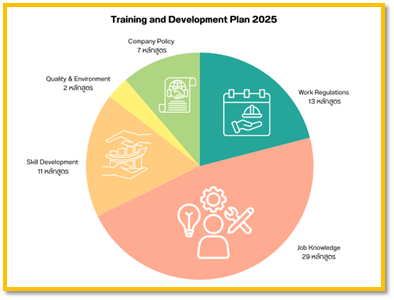
The company is committed to enhancing the capabilities of employees at all levels by providing training opportunities through both public and private sector programs. Additionally, internal training sessions are conducted by in-house experts to equip employees with the necessary knowledge, job-specific skills, and competencies required for their roles (Functional Competency). These training initiatives align with operational procedures under the company's quality and environmental management system. For 2025, the company has established an annual training plan covering the following areas:
(1) Work Rules and Regulations Training – 21%
(2) Position-Specific Knowledge Training – 47%
(3) Knowledge and Skills Development Training – 18%
(4) Quality and Environmental Management Training – 3%
(5) Business Ethics, Anti-Corruption, and Good Corporate Governance Training – 11%
Plan Areas
| Plan Area |
|---|
| Fair employee compensation |
| Employee training and development |
| Promoting employee relations and participation |
| Migrant/foreign labor |
| Child labor |
| Occupational health and safety in workplace |
Employees — Workforce
Workforce Data
| Metric | Current Year | Previous Year | Two Years Ago |
|---|---|---|---|
| Total number of employees (Persons) | 215 | 241 | 251 |
| Number of male employees (Persons) | 150 | 172 | 182 |
| Number of female employees (Persons) | 65 | 69 | 69 |
| Total employment of disabled persons (people) | 1 | 1 | 1 |
| Total disabled employees (people) | 1 | 1 | 1 |
| Total male disabled employees (people) | 0 | 0 | 0 |
| Total female disabled employees (people) | 1 | 1 | 1 |
| Total disabled workers who are non-employee (people) | 0 | 0 | 0 |
| Contributions to the fund for promoting and improving the quality of life for disabled persons | 1 | 1 | 1 |
| Total number of male employees in operational level (Persons) | 143 | 157 | 168 |
| Total number of male employees in management level (Persons) | 6 | 13 | 12 |
| Total number of male employees in executive level (Persons) | 1 | 2 | 2 |
| Total number of female employees in operational level (Persons) | 56 | 56 | 57 |
| Total number of female employees in management level (Persons) | 7 | 10 | 10 |
| Total number of female employees in executive level (Persons) | 2 | 3 | 2 |
Employees — Remuneration & Provident Fund
Remuneration & Provident Fund
| Metric | Current Year | Previous Year | Two Years Ago |
|---|---|---|---|
| Total disabled employees (people) | 89,063,577.5 | 97,253,808.19 | 92,440,198.95 |
| Total male employee remuneration (Baht) | 52,796,396.22 | 62,950,705.18 | 60,644,037.54 |
| Total female employee remuneration (Baht) | 36,267,181.28 | 34,303,103.01 | 31,796,161.41 |
| Number of employees eligible to participate in PVD (persons) | 215 | 241 | 251 |
| Total number of employees joining employee provident fund (Persons) | 132 | 134 | 187 |
| Percentage of total number of employees joining employee provident fund to total number of employees (%) | 61.4 | 55.6 | 74.5 |
| Number of PVD members / Total eligible employees (%) | 61.4 | 55.6 | 74.5 |
| Total amount of provident fund contributed by the Company (Baht) | 3,306,719.87 | 3,462,672.02 | 2,887,283.07 |
| Total amount of provident fund contributed by employee (baht) |
Employees — Training & Development
Training Data
| Metric | Current Year | Previous Year | Two Years Ago |
|---|---|---|---|
| Average employee training hours (Hours / Person / Year) | 13 | 10.7 | 16 |
| Employee development and training expenses (baht) | 295,934.95 | 298,848.69 | 230,903.38 |
Employees — Occupational Health & Safety
Occupational Health & Safety Data
| Metric | Current Year | Previous Year | Two Years Ago |
|---|---|---|---|
| Total number of lost time injury incidents by employees (Cases) | 1 | 0 | 0 |
Employees — Labour Relations
Labour Relations Data
| Metric | Current Year | Previous Year | Two Years Ago |
|---|---|---|---|
| Total voluntary resignations (Persons) | 29 | 33 | |
| Male employees who voluntary resigned (Persons) | 24 | 25 | |
| Female employees who voluntary resigned (Persons) | 5 | 8 | |
| Percentage of employee turnover leaving the Company voluntarily (%) | 12.81 | 13.69 | |
| Evaluation result of employee engagement | 0 | 0 | 0 |
Employees — Employee Representation
Employees Are Represented Collectively
Yes
Forms of Representation
| Form |
|---|
| Welfare committee |
Employees — Targets
Has Set Employee Targets
Yes
Targets
| Indicator | Target Areas | Base Year | Base Year — Description | Target Year | Target Year — Description |
|---|---|---|---|---|---|
| % of employees receiving wages not lower than minimum wage | 2983 · Description: Fair employee compensation | 2,025 | 100% | 2,028 | Maintain at 100% |
| Average training hours per employee per year | 2984 · Description: Employee training and development | 2,025 | 13 hours/person/year | 2,028 | ≥ 20 hours/person/year |
| Employee satisfaction/engagement level | 2985 · Description: Promoting employee relations and participation | 2,025 | Under development | 2,027 | Establish survey and target by 2027 |
| Compliance with applicable laws related to migrant labor | 2986 · Description: Migrant/foreign labor | 2,025 | No migrant workers employed | 2,026 | 100% compliance (if applicable)
Target Year: 2026 (and ongoing) |
| Number of child labor cases / discrimination complaints | 2987 · Description: Child labor | 2,025 | 0 cases | 2,026 | Zero cases |
| Number of work-related accidents | 2988 · Description: Safety and occupational health at work | 2,025 | 1 case of lost time injury
| 2,028 | Reduce to zero cases |
| Number of discrimination complaints | 2989 · Description: Non-discrimination | 2,025 | 0 cases | 2,028 | Zero cases |
Employees — Performance & Outcomes
Has Performance Results
Yes
Performance Description
In 2025, which serves as the baseline year, the Company initiated the implementation of its employee and labor management framework across key areas. In terms of training and development, the Company carried out its annual training plan, with training programs categorized as follows: work rules and regulations (21%), position-specific knowledge (47%), knowledge and skills development (18%), quality and environmental management (3%), and business ethics, anti-corruption, and good corporate governance (11%).
In 2025, the Company conducted a total of 55 training programs in accordance with its annual training plan, covering both internal and external training. These programs encompassed a wide range of technical and skill development areas, including import–export accounting documentation analysis and problem-solving, energy management for designated factories, forklift operation (≤10 tons, Level 1), halal entrepreneur development, induction motor repair and maintenance, and business ethics and corporate governance.
For other areas, including fair compensation, employee engagement, migrant labor, child labor, and occupational health and safety, the Company is in the process of developing management frameworks, KPIs, and targets to support effective monitoring and evaluation in subsequent years.
Customers — Plan & Guidelines
Has a Customer Management Plan
Yes
Plan Description
Production and Services with Customer Responsibility: We have plans to develop and improve the production process to ensure higher standards, increase customer response efficiency by utilizing technology for faster and more accurate services, and provide employee training to equip them with skills for effective customer service and problem-solving.
Listening to Customer Feedback and Satisfaction: We have implemented a system to survey customer satisfaction through various channels such as online surveys or customer interviews. We also plan to analyze the customer satisfaction data to use it in improving products.
Product and Service Development Based on Customer Needs: We analyze market trends and customer demands to develop products, plan improvements to existing products to meet the needs of customers in all target groups, and create new product development plans using customer and market data in the design and development process.
Building Long-term Relationships with Customers: We aim to strengthen long-term relationships with customers by planning to create loyalty programs to retain regular customers and follow up after sales.
Protection of Customer Personal Data: We have created and updated policies for privacy and the protection of customer personal data in accordance with relevant laws. We use secure data storage systems with encryption technology to prevent unauthorized access. We have also established clear processes and steps for obtaining customer consent before collecting personal data and for disclosing information according to applicable legal requirements.
Plan Areas
| Plan Area |
|---|
| Responsible production and services for customers |
| Communication of product and service impacts to customers/consumers |
| Development of customer satisfaction and customer relationship |
| Protection of customer personal information |
Customers — Satisfaction Results
Customer Satisfaction Results
| Metric | Current Year | Previous Year | Two Years Ago |
|---|---|---|---|
| Evaluation results of customer satisfaction | 1 | 1 | 1 |
Customers — Targets
Has Set Customer Targets
Yes
Targets
| Indicator | Target Areas | Base Year | Base Year — Description | Target Year | Target Year — Description |
|---|---|---|---|---|---|
| Number of product quality complaints | 3007 · Description: Responsible production and services for customers | 2,025 | 0 cases | 2,028 | Zero cases |
| % of customers receiving complete product information | 3008 · Description: Communication of product and service impacts to customers/consumers | 2,025 | 100% | 2,028 | Maintain at 100% |
| Number of customer complaints | 3009 · Description: Development of customer satisfaction and customer relationship | 2,025 | 0 cases | 2,028 | Zero cases |
| Number of data breach incidents | 3010 · Description: Consumer data privacy and protection | 2,025 | 0 cases | 2,028 | Zero cases |
Customers — Performance & Outcomes
Has Performance Results
No
Performance Description
In 2025, the Company collected and analyzed relevant data on customer management to establish KPIs and targets for future operations. The year therefore serves as the baseline for subsequent monitoring and performance evaluation.
Community & Social — Plan & Guidelines
Has a Community & Social Plan
Yes
Plan Description
Support for Education in the Community: The company plans to support education or organize learning activities for children and youth in the local area. Environmental Development in the Community: The company has collaborated with the community to organize tree planting activities to promote environmental sustainability by donating saplings grown in-house from economic forest trees. Employees and community members participated in this activity together. Development of Vocational Skills for Community Members: The company plans to hire employees or workers from the local community or nearby areas, which helps create job opportunities and improve the quality of life. Promotion of Local Culture and Traditions: The company has supported and participated in cultural and traditional activities in the community, such as local festivals like Songkran and Loy Krathong, as well as organizing local art and cultural performances. This is done to preserve and promote the cultural values of the area by providing resources and activities that allow community members to engage and express their cultural identity.
Plan Areas
| Plan Area |
|---|
| Employment and professional skill development |
| Education |
| Religion and culture |
| Forests and natural resources |
Community & Social — Targets
Has Set Community & Social Targets
No
Community & Social — Performance & Outcomes
Has Performance Results
Yes
Performance Description
The Company has recruited employees to work at the factory, with a focus on selecting individuals from the local area in Suphanburi Province, particularly from the surrounding communities. Currently, 80% of the employees are local residents of Suphanburi. In 2026, the Company will continue to recruit local employees for factory operations to meet its target.
Law Violation Incidents
Law Violation Incidents
| Metric | Current Year | Previous Year | Two Years Ago |
|---|---|---|---|
| The total number of cases or incidents of significant violations of laws or regulations regarding social and human rights (Cases) | 0 | 0 | 0 |
| The total number of cases or incidents that cause significant labor disputes (Cases) | 0 | 0 | 0 |
| The total number of cases or complaints related to consumer rights violations (Cases) | 0 | 0 | 0 |
| The total number of cases or complaints related to partner rights violations (Cases) | 0 | 0 | 0 |
| The total number of cases or incidents that cause disputes with the community/society (Cases) | 0 | 0 | 0 |
| The total number of cases or incidents related to cyber security or customer data breaches (Cases) | 0 | 0 | 0 |
| The total number of cases or incidents related to safety and occupational health at work (Cases) | 0 | 0 | 0 |